

ISIS-K: TERROR WITHOUT BORDERS
The global jihadist threat crossing continents

Introduction
The Islamic State in Khorasan Province (ISIS-K, ISKP) has emerged as one of the largest and most complex threats to jihadist terrorism today. As the official branch of the Islamic State (ISIS), ISIS-K operates primarily in Afghanistan and Pakistan, expanding its influence throughout Central Asia and beyond, always with the stated goal of building a global caliphate and instilling terror beyond its traditional borders. Its emergence, consolidation, and subsequent adaptation to changes in the Afghan landscape and the collapse of the central ISIS have received special attention from international organizations, security analysts, and the media. The group’s ability to survive and reinvent itself, even after the loss of territory and leadership, has made it a key player in the global threat landscape.

Founding and historical context
ISIS-K was officially founded in January 2015 as the recognized affiliate of the Islamic State in the Khorasan region, traditionally encompassing Afghanistan, Pakistan, and parts of Central Asia. The initial leaders and fighters were former members of the Afghan and Pakistani Taliban, as well as experienced members of the Islamic Movement of Uzbekistan. This convergence of forces managed, in just a few months, to consolidate territorial control in several rural districts, especially in northern and northeastern Afghanistan, and to launch a lethal campaign that included Pakistan as one of its main operational theaters.
The group strategically chose to position itself in Afghanistan’s Nangarhar province, bordering Pakistan’s tribal areas and historically linked to strongholds of al-Qaeda and other radical organizations. The location allowed continuous access to supplies, weapons, and recruits. The period from 2015 to 2018 was crucial in the group’s consolidation, whose growth was sustained by the local experience of its commanders and alliances with tribal and criminal networks.
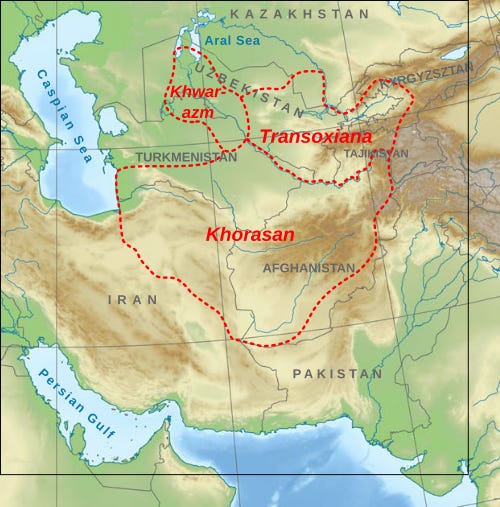
Greater Khorasan and neighbouring regions
Territorial expansion and consolidation
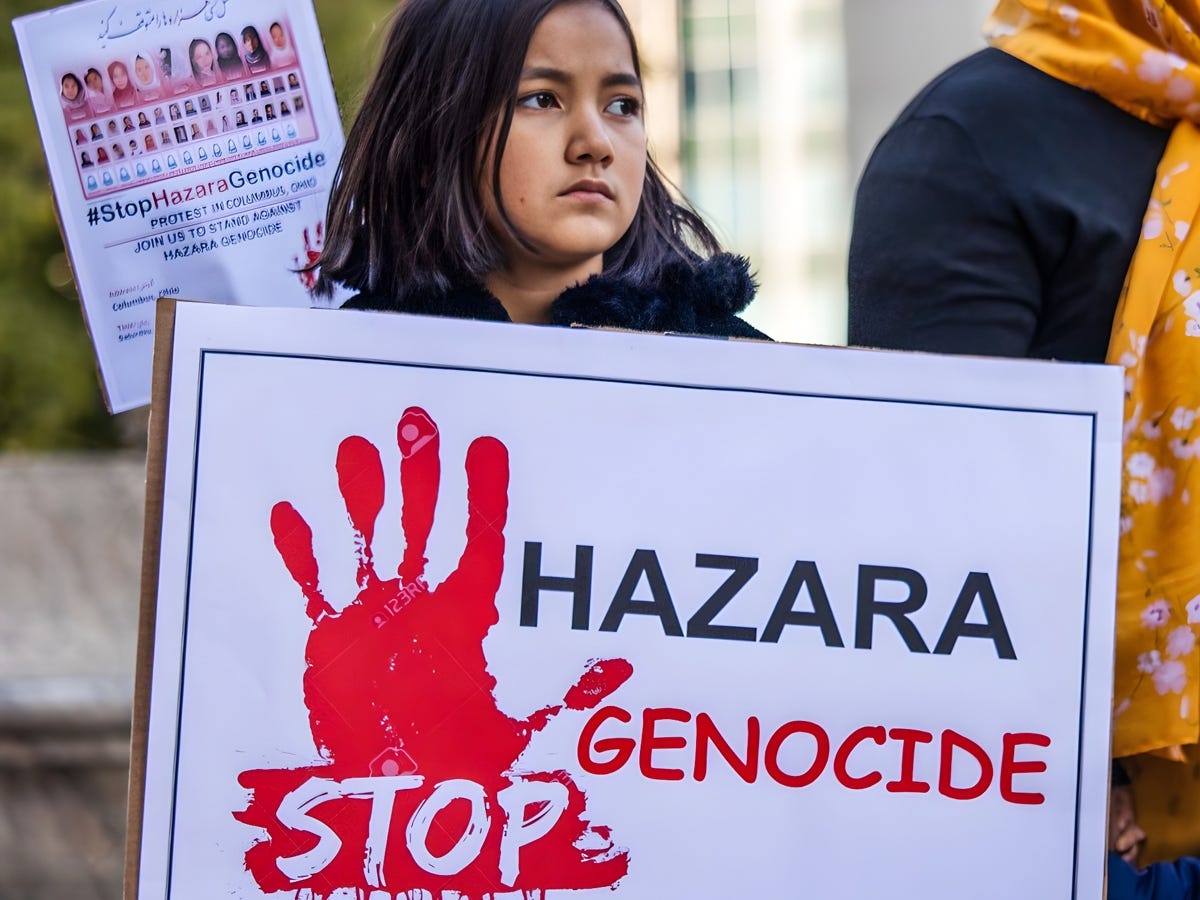
In its first three years, ISIS-K consolidated its power centers in Afghanistan and launched attacks against ethnic and religious minorities (Hazara, Sikh), public institutions, and government targets in major cities in Afghanistan and Pakistan. By 2018, the group had been ranked by the Global Terrorism Index as one of the four deadliest organizations in the world. The casualty figures and the indiscriminate nature of its attacks made it a priority among counterterrorism experts and international organizations.
ISIS-K’s expansion was facilitated, in part, by the institutional collapse caused by the gradual withdrawal of US and NATO forces, as well as the vacuum left by the weakness of the Afghan government. At its peak, the group maintained hundreds of fighters and secure strongholds from which it coordinated operations and propaganda campaigns. It is estimated to have received more than $100 million in direct fundraising, training, and advice from the Islamic State’s organizational core in Syria and Iraq, which has shaped its technical and operational profile.
Adapting to losses and resilience
In late 2019 and early 2020, the combined pressure of US military strikes, Taliban operations, and Afghan campaigns led to the surrender of more than 1,400 ISIS-K fighters and family members. Despite the declaration of defeat, the group demonstrated a strong capacity for resilience. The internal succession phenomenon, where leaders were quickly replaced after executions, helps explain its longevity.
In the last five years, the group has been able to reinvent its tactics and modus operandi. The loss of physical territory did not mean its extinction: they resorted to mobile cells, alliances with local criminal groups, and sophisticated networks to maintain their operations. The ideology of the “global caliphate” remained the strategic compass, and ISIS-K affiliates managed to establish a presence in Tajikistan, Uzbekistan, Iran, the Caucasus, and, more recently, Africa, connecting with other regional branches.
Objectives and ideological strategy
ISIS-K seeks to destabilization of Taliban control and delegitimize any state authority in Afghanistan and the region. They point to the incompetence of the Afghan Taliban government and seek to attract disillusioned fighters from other jihadist groups under the promise of ideological “purity” and direct action. Their propaganda targets both veteran guerrillas and radicalized urban youth.
The group has established ties with the ISIS core, receiving tactical advice, financial resources, and media support. Its focus is on sowing chaos, exploiting operational gaps, and generating the greatest possible impact through high-profile and brutal attacks.
Relations with the Taliban and regional dynamics
Since its inception, ISIS-K has presented itself as the main rival of the Afghan Taliban, branding them as “nationalists” and accusing them of abandoning authentic jihad to negotiate with foreign powers. This has resulted in direct clashes over territorial control and the loyalty of combatants. On occasion, the Taliban have launched joint military operations with US and Afghan forces, severely impacting ISIS-K’s human and logistical resources but failing to completely eradicate the group.
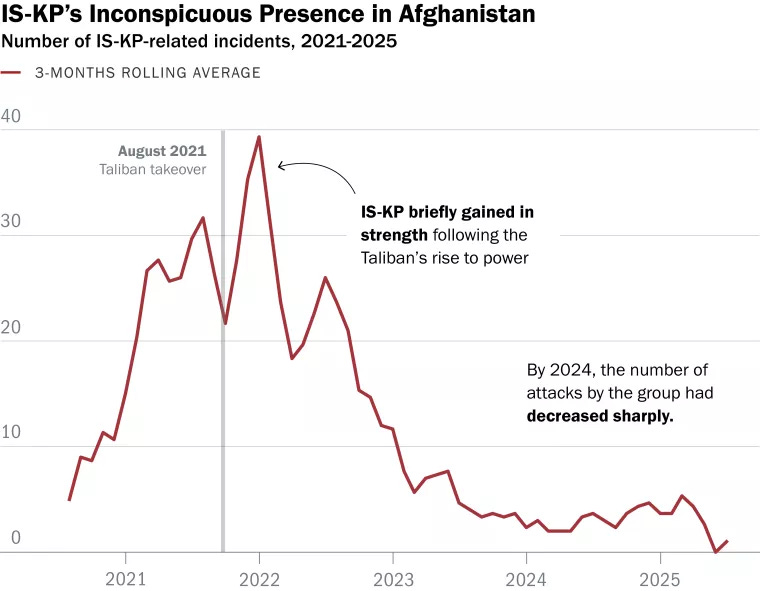
After briefly gaining strength following the Taliban’s rise to power, IS-KP has staged far fewer attacks in recent years. The group is down but not out. Source: Crisis Group calculations based on ACLED data.
International impact and persistent threat
The holistic expansion of ISIS and the emergence of affiliates such as ISIS-K demonstrate the global reach of contemporary jihadist terrorism. The group remains capable of perpetrating transnational massacres, such as the attack on Crocus City Hall in Moscow in 2024, and attacks in Syria, Iran, and beyond, always under the rationale of instilling terror and punishing “infidels” and enemy governments. Its adaptability and survivability cement its position as one of the most complex phenomena in the current international security landscape.
European officials say around 90 per cent of the terrorist plots in Europe between 2022 and 2024 have been linked to ISIS-K.
Russia and Iran are the two countries most vulnerable to ISIS-K attacks. Plots to wreak destruction and kill civilians in these countries involve interconnected networks and older militants who travel back and forth from Afghanistan, receive direct instructions from ISIS-K commanders, and conduct more complex assaults than in the West.
European security services, for their part, distinguish between “autonomous” and “activated” threats, with the difference hinging on the role of ISIS-K commanders abroad.
The first type of militant is usually a young adult or an adolescent who is inspired by ISIS-K and may contact its commanders through social media. These individuals tend to feel socially excluded. ISIS-K’s recruitment of them tends to be more opportunistic than carefully coordinated. The recruits may be inexperienced, but ISIS-K commanders calculate that only a few need to succeed in pulling off an attack in order for the organisation to accomplish its objectives. Even so, their interactions with ISIS-K commanders via social media help explain the high number of failed plots: the U.S. captures their communication via electronic surveillance and shares it with European partners, who are increasingly gathering this sort of intelligence as well.
The second, “activated”, type of militant tends to be of Central Asian origin, usually Tajik or Uzbek, or from the countries of the Caucasus. In some cases, these militants are recruited when they are already settled in Europe; in other cases, they are dispatched to these countries. Either way, they tend to know little about their host societies and lack the contacts needed to establish networks through which to acquire weapons. They also live under the radar, making it difficult for them to organise large-scale assaults. Some of them were involved in jihad before joining ISIS-K, but not always. As newcomers to the West, they generally do not interact with local, younger militants, with a few exceptions.
Today, next to none of the new recruits have travelled to jihadist battlefields or received training. The recruits are often too young to have been in Syria when ISIS held territory there, and the individuals previously arrested for travelling to Syria are not – for the moment – involved in new plots. Going to Afghanistan from Europe is nearly impossible, with only a few cases of people having tried to do so. That stands in stark contrast to the ease of entering Syria from Türkiye at the peak of the Syrian conflict. ISIS-K now advises its sympathisers to act where they are, rather than attempting a trip to Afghanistan.
None of the above means there is no threat to Western countries. In 2024, U.S. authorities arrested people of Central Asian origin allegedly linked to IS-KP who were attempting to infiltrate the U.S. from Mexico. Their capture fuelled fears that attacks in the U.S. could be in the offing. Militants from Central Asia have already tried to get to Europe through Ukraine, posing as refugees. Some had spent time in Syria beforehand. There is also a risk, as witnessed on several occasions in Germany, of individuals whose asylum applications are rejected by authorities resorting to violence. Their attacks tend to lack sophistication. Still, even if they are acting on the spur of the moment, the result may be lethal, bringing backlash.
Major attacks and actions
December 2017 attack on a Christmas market in Strasbourg, France.
Kabul airport attack (2021): Suicide attack with dozens of deaths, including many civilians and Western forces.
Massacres in Afghan schools and hospitals, with dozens of victims.
Crocus City Hall, Moscow (March 2024): Suicide and armed attack with more than 140 fatalities.
Attacks in Iran (2027, 2023 and 2024) at religious events. Larger attack in Kerman, deploying a double suicide bombing during a ceremony outside the tomb of Major General Qassem Soleimani, a total of 91 people were killed.
New Orleans (January 2025): Massive attack claimed by ISIS-K, demonstrating the exportability of the terrorist model.
Syria (2025): Bomb attacks on Christian and Muslim places of worship, evidencing the reactivation of sleeper cells.
To differentiate itself from the Taliban, ISIS-K pursued its own priorities, notably by attacking Shia Muslims and extending operations beyond Afghanistan immediately after it emerged. Major incidents included a suicide bombing in Jalalabad, Afghanistan in April 2015, killing 33 people; an attack on the Pakistani consulate in Jalalabad in January 2016; a devastating bombing targeting Hazara Shia in Kabul in July 2016, killing 97; and the bombing of a Sufi saint’s shrine in Khuzdar, Pakistan, in November 2016, resulting in 55 deaths.
Internal organization and leadership
ISIS-K exhibits a relentless pyramidal structure, emulating the central model of the Islamic State. At the top is the regional emir, who holds supreme authority over operations, doctrine, and strategy. Beneath the leader are advisory councils and select commanders responsible for key areas: logistics, military operations, finance, propaganda, and digital radicalization.
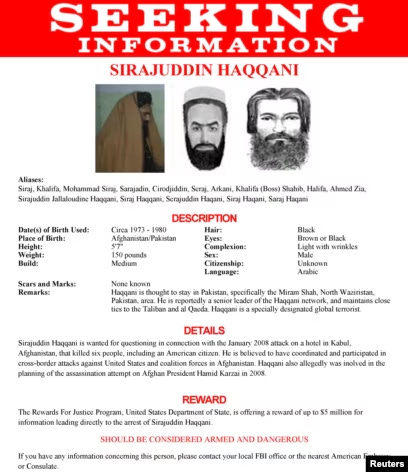
The group’s tactical and operational flexibility relies on autonomous cells capable of acting with minimal central coordination. This organic design allows them to withstand military attacks and leadership losses, quickly replacing figures eliminated by US, Afghan, or Taliban forces. Temporary alliances, such as those maintained with the Haqqani network, facilitate the timely exchange of resources and intelligence, but the ideology remains rigidly faithful to the global caliphal model, repudiating any limited state concept like that of the Afghan Taliban.
Particularly relevant is the role assigned to technological and financial experts. They strengthen communications security, launch propaganda campaigns, and manage funds from multiple sources: ideological donations, illicit activities, extortion, and digital transfer systems (cryptocurrencies). Support networks, including cells in Central Asia and urban areas of Pakistan and Afghanistan, act as logistical and human reservoirs.
Operational capacity and resources
The ISIS-K group has maintained a mechanically consistent operational capacity, even after severe human and territorial losses. According to reports submitted to the UN Security Council, its persistence and adaptation have been remarkable: the death of senior leaders barely affects overall operations, due to the system of automatic and invisible replacements.
The main area of operation extends across the Afghan provinces of Nangarhar and Kunar, although regional expansion incorporates cells in Pakistan, Tajikistan, Uzbekistan, northern Iran, and the Caucasus. The organization fosters fighter mobility, infiltration into vulnerable communities, and the exploitation of local power vacuums. On occasion, prisoners of war released in Afghanistan have added muscle and experience to ISIS-K’s ranks, honing tactics and making the threat more complex.
The financing capacity is based both on support received from the Syrian and Iraqi core of ISIS—including remittances exceeding $100 million during peak periods—and on local activities: smuggling, illicit trafficking, extortion, kidnappings, and criminal networks. The use of cryptocurrencies helps circumvent international controls and enables rapid transfers to operational cells throughout Asia.
International expansion and projection strategy
The group’s strategy is divided into two main axes: regional consolidation and international expansion. In Afghanistan, ISIS-K seeks to weaken the Taliban, sabotage state authority, and attract dissident fighters from other jihadist organizations. In Central and South Asia, the model aims to replicate the “digital caliphate,” radicalizing through audiovisual propaganda and high-impact spectacular attacks.
In recent years, the territorial expansion and emergence of ISIS-K-inspired cells have been constant in regions such as Syria, Iran, the Caucasus, and the Sahel, where the organization exploits political instability and security gaps. The propaganda, aimed at young people and vulnerable communities, emphasizes the “Islamic awakening” and the idea that no local government can guarantee security, justice, or authentic Islamic life.
The group has demonstrated a capacity to carry out transnational attacks and high-profile massacres, such as the Kabul airport attack (2021), the Moscow massacre (2024), and attacks in Syria and Iran. The use of technology and social media amplifies the psychological impact of terrorism, inspiring low-cost actions by digitally radicalized lone actors in Europe, the Americas, and Asia.
Timeline of ISIS-K’s evolution
ISIS-K, as the official affiliate of the Islamic State, emerged in 2015 after the initial expansion of the self-proclaimed caliphate in Syria and Iraq. Since then, its chronology is as follows:
2015-2017: Consolidation of presence in Afghanistan and Pakistan. Launch of recruitment campaigns and seizure of districts in Nangarhar and Kunar, with attacks against minorities and security forces.
2018-2020: Intensification of mass attacks, sectarian persecution, and development of urban cells. Incursion into Central Asia, especially Tajikistan and Uzbekistan.
2021: Attack at Kabul airport during the evacuation of Western forces, with dozens of deaths. The group takes advantage of the institutional collapse following the US withdrawal.
2022-2023: Strong combined military pressure from the Taliban, the US, and Afghan forces, with numerous casualties and surrenders, but without eradicating the group.
2024: Attack on Crocus City Hall in Moscow, with 145 fatalities. Its capacity for international influence and coordination with cells inspired by Asia and Europe are confirmed.
2025: Operational persistence, expansion in the African Sahel, attacks in Syria, and new forms of financing and digital propaganda.
Types of attacks and social and humanitarian impact
The attacks perpetrated by ISIS-K cover a broad and lethal spectrum:
Suicide attacks: Used in high-traffic areas such as airports, markets, and mosques.
Sectarian massacres: Attacks against Hazara, Sikh, and Christian minorities, with the aim of increasing religious polarization.
Transnational operations: A clear example is the Moscow attack (2024), coordinated by cells outside Afghanistan.
Attacks using drones and homemade explosives: Tactical innovation to circumvent military and police checkpoints.
Low-cost or solo actions: Radicalization of individual actors in the West through digital propaganda, promoting low-cost attacks with high media impact.
ISIS-K terrorism has devastated Afghanistan and surrounding regions through the mass displacement of tens of thousands of people have fled provinces under constant threat. With the destruction of communities, markets, schools, hospitals, and places of worship have been attacked, generating waves of panic and ongoing trauma. Through the sectarian persecution, Hazara and Sikh communities have suffered systematic massacres, fueling further ethnic and religious polarization and generating humanitarian crisis, fear and insecurity delay the return of displaced populations and hamper reconstruction efforts and international aid.
Digital propaganda analysis
ISIS-K has perfected its use of social media and emerging technologies, through different channels of dissemination, Telegram, the dark web, X, and specialized forums to coordinate attacks, disseminate videos, and radicalize supporters. The use of Artificial Intelligence and Cryptography, to evade international surveillance, create high-quality content, and foster digital recruitment. The key narratives, the promotion of the idea of a “global caliphate,” martyrdom, calls for universal jihad, and incitement of sectarian hatred. The languages and targeting with material in Arabic, Pashto, Urdu, English, Russian, and local languages to expand the follower base and inspire international cells.
Key leaders
The leadership of ISIS and its affiliates has changed frequently due to foreign military action, but they demonstrate great resilience:
Abu Bakr al-Baghdadi (2014-2019).
Abu Ibrahim al-Hashemi al-Quraishi (2019-2022).
Abu al-Hashan al-Qurashi (2022).
Abu al-Hussein al-Husseini al-Qurashi (2022-2023).
Abu Hafs al-Hashemi al-Qurashi (2023-present), is the fifth and current caliph of the Islamic State. He was named as caliph on 3 August 2023.
In the context of ISIS-K, the local leadership is constantly renewed; although their names often remain secret for security reasons, the regional emir regularly appoints and dismisses middle-level leaders, allowing for persistence after strategic losses.
Relations with other jihadist networks
ISIS-K maintains ambiguous and complex ties, traditional rivalry with the Taliban, competing for territory and ideological loyalty, with frequent violent clashes. There are specific contacts with the Haqqani network, exchange of intelligence, logistics, and recruitment, although without a formal alliance. The tactical cooperation with African and Asian branches of ISIS, coordination in propaganda and training operations, especially in the Sahel and Central Asia. Incorporation of released prisoners, the group absorbs experienced fighters released after the regime change in Afghanistan or through prison operations.
Foresight
International reports agree that ISIS-K will remain a significant threat:
Adaptation and resilience: The ability to overcome losses of leadership and territory makes it unpredictable and dangerous.
Expansion of the “digital caliphate” model: Increased use of artificial intelligence, cryptocurrencies, and multimedia propaganda.
International reach: An increase in attacks is expected in Europe, Africa, Central Asia, and the Americas by digitally radicalized actors and mobile cells.
International response: The UN Security Council urges global cooperation, human rights-based prevention, and a multidisciplinary approach.
Western countries’ focus has shifted from ground battles and airstrikes to combating ISIS’s decentralised network. They need an approach that is more rooted in law enforcement, including enhanced collaboration on issues like tracking travel, disrupting financial networks and tackling cross-border smuggling. Additionally, building the capacity of Central Asian countries to address new threats is crucial, given the region’s role as a transit and recruitment hub.
As matters stand in mid-2025, ISIS-K is at a low ebb. But its intent to strike has not faded. The group appears to be expanding its presence in Balochistan, as highlighted in a recent propaganda video. In June, Taliban forces raided a facility in Kabul used for manufacturing explosives and suicide vests. Although the group’s weaknesses are evident, it seems that the ISIS-K remains committed to attracting foreign fighters and plotting attacks beyond Afghanistan’s borders.
References
¿Qué es el ISIS-K?. https://ethic.es/2021/08/que-es-el-isis-k/
Compendio de casos relativos a la lucha contra el terrorismo. https://www.unodc.org/documents/terrorism/09-86637_ebook_Spanish.pdf
Terrorismo y movimientos migratorios en Europa. https://www.defensa.gob.es/documents/2073105/2223504/cap+3+monografia+153.pdf/326c030b-f73a-4b22-0103-2be3eb8b08ef?t=1729595260499
ISIS: diez años de terror. Instituto de Relaciones Internacionales, UNLP. https://www.iri.edu.ar/index.php/2025/05/28/isis-diez-anos-de-terror/
El grupo terrorista Daesh mantiene su capacidad operativa pese a pérdida de líderes. ONU Noticias. https://news.un.org/es/story/2025/08/1540349
Without Borders: The Haqqani Network and the Road to Kabul. Jere Van Dyk.
Afganistán: qué se sabe de ISIS-K. https://www.bbc.com/mundo/noticias-internacional-58337686
La lucha regional contra el ISIS-K ¿incapacidad o falta de voluntad. https://global-strategy.org/la-lucha-regional-contra-el-isis-k-incapacidad-o-falta-de-voluntad/
The Islamic State in Afghanistan: A Jihadist Threat in Retreat? https://www.crisisgroup.org/asia/south-asia/afghanistan/b183-islamic-state-afghanistan-jihadist-threat-retreat
Afghanistan’s Security Challenges under the Taliban. Crisis Group Asia Report N°326, https://www.crisisgroup.org/asia-pacific/afghanistan/326-afghanistans-security-challenges-under-taliban